
Our Work
About Our Education System
About Mayoral Control
History of Mayoral Control
Our education system has come a long way since the late 1990s and the early 2000s. DC was ranked last in the country on the 2007 National Assessment of Educational Progress (NAEP), with only 12% of eighth graders proficient in reading and 8% proficient in math. Only 43% of DC students graduated from high school in five years in 2006, compared to the national average of 68%. DC needed to make a change. As a result, in 2007, after intense conversations between our elected officials, community leaders, families, and educators, DC made the choice to shift our governance structure from a traditional school board model to mayoral control. In April of 2007, the DC Council passed the Public Education Reform Amendment Act (PERAA), which gave control of DC public schools to the Mayor. Under mayoral control, the Mayor sets the vision for DC education and is given top authority over governing schools and our education agencies. We moved to mayoral control nearly 20 years ago and we are one of the only jurisdictions across the nation to maintain this unique approach to education governance.Structure of Mayoral Control
To lead this work, the Mayor appoints a Deputy Mayor of Education (DME) who oversees all DC public schools. Other key players include the DC Council, DC Public Schools (DCPS), the DC Public Charter School Board, the Office of the State Superintendent of Education, and the DC State Board of Education.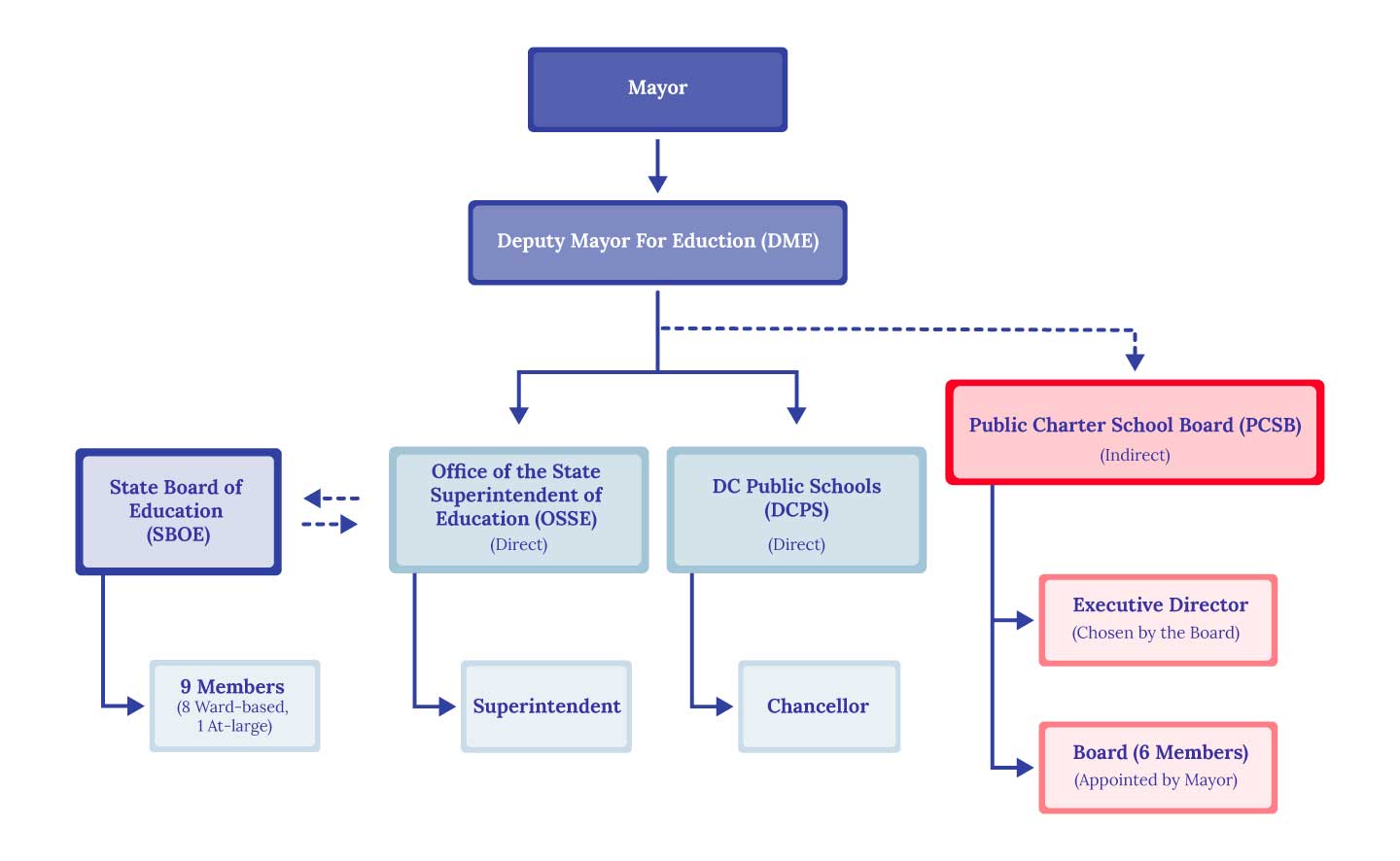
Education Agency Leaders & Their Role
Mayor
- The Mayor sets the overarching vision for education in the District of Columbia and serves as the ultimate decision-maker for the public school system.
- Under mayoral control, the Mayor appoints key education leaders, including the DME, Chancellor of DCPS, DC Public Charter School Board members, and other senior officials; provides strategic direction to align education with citywide priorities; proposes the budget for education and related initiatives; and serves as the publicly accountable, elected leader responsible for the success of educational outcomes across the District.
Deputy Mayor for Education
- The Deputy Mayor for Education (DME) is responsible for developing and implementing the Mayor’s vision for education.
- The DME advises the Mayor on education policy and also manages the DC Public Library, Department of Parks and Recreation (DPR), University of the District of Columbia (UDC), and the Office of Out-of-School Time programs.
- The DME oversees all public schools. The DME directly manages both the Office of the State Superintendent of Education (OSSE) and DC Public Schools (DCPS). The DME indirectly manages public charter schools, as each Local Education Agency (LEA) is publicly funded and independently operated, and each must follow all education laws in DC with a higher degree of transparency and accountability.
- The DME is appointed by the Mayor and confirmed by the DC Council.
DC Public Schools
- DC Public Schools (DCPS) is the traditional public school system in the District. DCPS is a system of neighborhood schools with some selective school options, and students can apply to attend an out-of-boundary DCPS school through the My School DC lottery.
- DCPS is under direct mayoral control and is subject to DC Council performance and budget oversight. The mayor nominates the DCPS Chancellor, who is confirmed by the DC Council. The Chancellor is responsible for the overall leadership and strategic direction of DCPS. The Chancellor reports directly to the DME.
DC Public Charter School Board (PCSB)
- The DC PCSB authorizes public charter schools in DC. The PCSB is governed by a seven-member board, nominated by the Mayor with the consent of the DC Council. The board approves new schools, provides oversight to operating schools, and revokes a school’s charter if it fails to meet its performance goals.
- Each public charter school operator that PCSB authorizes and oversees is a non-profit run by its own Board of Trustees and is considered a Local Education Agency (LEA) under federal guidelines. Public charter LEAs are funded publicly but operated independently.
- While the DC Public Charter School Board, an independent DC government agency, is subject to mayoral and DC Council oversight, the exclusive autonomy individual charter LEAs have means they are not under the direct control of the mayor.
Office of the State Superintendent of Education (OSSE)
- OSSE is the state education agency for DC. OSSE is responsible for ensuring compliance with federal law, administering federal grants, and overseeing standardized testing across the District. Additionally, OSSE provides resources on education matters, policy guidance, and administers transportation services for students with special needs.
- The State Superintendent of Education leads the work of OSSE and is appointed by the Mayor and confirmed by the DC Council.
State Board of Education (SBOE)
- The State Board of Education is composed of 9 elected representatives, one per ward and one at-large representative.
- The SBOE is responsible for approving state-level policies, including state academic standards, high school graduation requirements, and standards for high school equivalence credentials, among others, and advises the Office of the State Superintendent of Education on educational matters.
The DC Council
- The DC Council is made up of 13 elected representatives, including the Chairman and twelve other members, consisting of representatives from each of the District’s eight wards and four at-large members.
- The DC Council is the central and chief policymaking body for the District and is responsible for passing legislation, including our local budget, and providing oversight over the District’s many agencies, including those related to education.
- The Council does not currently have an education committee. The Council’s Education Committee last operated in December 2020. Education-related issues now fall under the responsibility of the Committee of the Whole (COW). The Committee of the Whole is composed of all 13 Councilmembers and is run by the Chairman of the Council.
Where Are We, Nearly 20 Years Later?
Over the past nearly two decades, we have seen progress in both traditional public and public charter schools. Student achievement has risen dramatically, with the latest 2024 NAEP results showing DC leading the nation in academic growth and pandemic recovery. In 2025, DC achieved our highest CAPE reading scores in the assessment’s history, while CAPE math scores posted the largest single-year growth on record.
In the last ten years, the Uniform Per Student Funding Formula (UPSFF) has grown by 60% reflecting a sustained commitment to providing schools with the resources needed to support high-quality teaching and learning. Enrollment in DC’s public schools continues to climb, even as public school enrollment declines nationally. These gains did not happen overnight or by chance—they are the result of consistent leadership and making sustained, intentional investments in its students, educators, and families.
History of Public Charter Schools and School Choice in DC
How Public Charter Schools Were Established in DC
Public charter schools were first established in DC following the passage of the District of Columbia School Reform Act of 1995 by Congress; because DC is not a state, Congress has jurisdiction over the District and is able to pass laws that directly affect how DC is governed. The DC School Reform Act allowed up to 20 charter local education agencies (LEAs) to open each year, with no enrollment cap. In negotiations between the federal government and local leaders in adding charter schools to the DC education landscape, the decision centered around providing greater autonomy and operational flexibility to schools in conjunction with increased accountability for student outcomes.
The DC Public Charter School Board (PCSB) was created in 1996 as a charter authorizer alongside what was then the DC Public School (DCPS) Board of Education, and became the sole charter authorizer after the DCPS Board of Education relinquished its charter authority in 2006. By 2006, just 10 years after the first charter schools opened in DC, 72 campuses were operational and over 25% of DC’s public school students attended a charter school.
Many of the first schools chartered in DC were founded by DC natives, DC educators, and DC community leaders:
- Paul Public Charter School was awarded its charter status in 2000, converting from Paul Junior High School in DCPS to a public charter school founded by long-time Paul Principal and DC educator, Cecile Middleton.
- Maya Angelou Public Charter School was founded in 1998 by two people who worked in the DC criminal justice system, including DC native James Forman, to engage disconnected youth in full-time, rigorous academic programs with innovative wraparound services they need to succeed.
- Carlos Rosario Adult Public Charter School was founded by DC educator, Sonia Gutierrez, who responded to cuts from the DC government to adult education programs, including her own award-winning model, by converting the school into the first adult public charter school in the country in 1998.
How Our Public School Choice System Evolved
The establishment of charter schools in DC laid the groundwork for the robust system of choice we have today, as families seeking alternatives to traditional public school options can apply for their children to attend a public charter school instead. As public charters created more public school options for students and families, offering a variety of innovations and specialized programs, DCPS also worked to improve the overall quality of schools and expand choice and program offerings within its system, including opening up the option to apply to out-of-boundary DCPS schools through the My School DC lottery.
The My School DC common lottery was established in 2014 as a single, streamlined process for families to apply for both out-of-boundary DCPS schools and public charter schools, making the system of choice easier to access for parents who previously may not have had the information or time needed to navigate a myriad of different application processes and deadlines for each school.
Current State of School Choice in DC
As of School Year 2025-26, there are 67 Local Education Agencies (LEAs) operating elementary, middle, and high schools, as well as schools specifically designated for adult, alternative, and special education students. DCPS is one LEA and the public charter sector has 66 LEAs, with 250 total schools across both sectors.
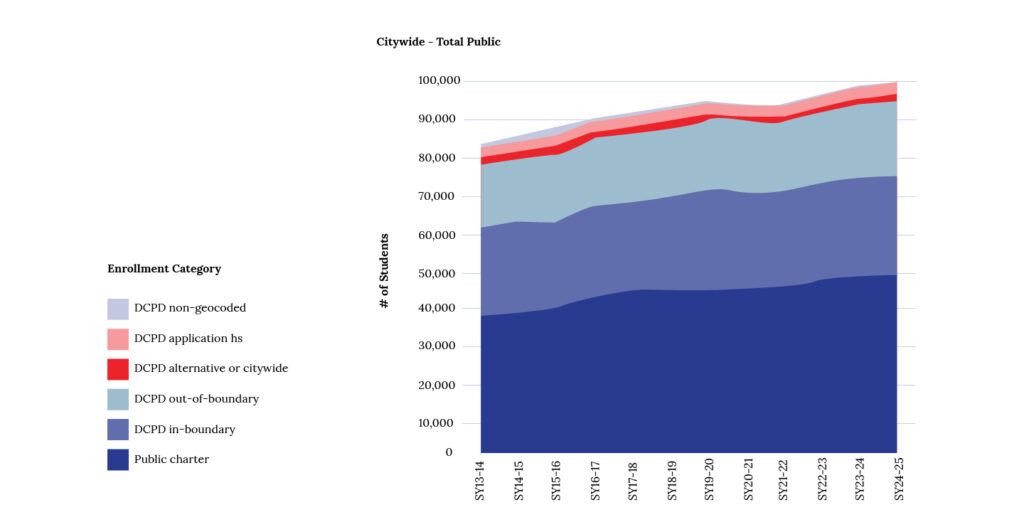
In the 2024-25 school year, 48% of all public school students attended public charter schools, and 52% attended a DCPS school. Within DCPS, about half of the students attend their in-boundary school, while the other half attend a DCPS school other than their neighborhood, by-right school.
Across both the traditional public and public charter school sectors, families across the District are empowered to choose the school that best meets their needs and prepares their kids for success after graduation. Regardless of which type of school their children attend, parents are happy with the options available to them: according to 50CAN’s report The State of Educational Opportunity in America which interviewed 20,000 parents across the nation, 86% of DC parents reported they have meaningful school choice, with 75% saying they’d make the same choice no matter where they live – higher than every other state. Both DCPS and public charter schools across the District offer a diversity of specialized school programs, including STEM, CTE, dual enrollment, classical education, programs with dynamic and innovative approaches to teaching math and reading, and more.
Assessments and Accountability in Our Schools
DC’s Academic Progress on NAEP and CAPE
DC has made remarkable progress over the past two decades, despite a pandemic that temporarily shuttered schools and impacted our children’s education in more ways than can be seen in test scores. In 2007, the average DC student was scoring 26 points below the national average, and by 2024, our students had closed that gap to 8 points and posted the highest gains from 2022-2024 compared to similar jurisdictions. The 2024 National Assessment of Educational Progress (NAEP) results showed DC as a bright spot on the National Education Recovery Scorecard, with DC ranking first among states in terms of recovery in math and reading between 2022 and 2024.
Most recently, the 2025 CAPE results, which measure results in English Language Arts (ELA) and math for grades three through eight, show remarkable results for DC students:
- Largest proficiency increases since the pandemic in both ELA and math, across all tested grades;
- ELA proficiency has surpassed pre-pandemic levels and is now the highest on record; and
- Math proficiency continues to climb rapidly, with the largest growth on record.
These historic gains show that DC’s education system is making bold progress, but progress at the citywide level only tells part of the story. Families, educators, and policymakers also need to understand how individual schools are performing, where gaps remain, and how resources can be directed most effectively. That’s where the DC School Report Card comes into play by providing a closer look at school-level data.

The DC School Report Card
The DC School Report Card is a tool developed by the Office of the State Superintendent of Education (OSSE), in partnership with parents, schools, and community members, to provide families and educators with clear and comparable information on every public and public charter school in DC. The goal of the report card is to promote transparency, help families make informed school choices, and highlight how well schools are serving their students, as well as areas for improvement.
The DC School Report Card came after the Every Student Succeeds Act (ESSA) was passed, which required all states and DC to publish annual school report cards with standardized data on student achievement and school quality. The DC School Report Card website was launched in December 2018 and gave families the ability to easily explore school profiles, compare performance among schools, and learn about specialized programs, making the report card an important resource for informed decision-making and transparency.
Beyond empowering families in making school choices, the report card has played a vital role in driving academic progress in DC. By shining a light on achievement gaps and outcomes for different student groups, it has helped educators and policymakers focus on targeted supports for schools and students who need them most. Schools use this data to identify strengths, address areas for growth, and adopt stronger instructional practices, while DC’s education agencies provide additional support to schools with lower ratings. Over time, the report card has fostered a culture of accountability and continuous improvement, ensuring that every student has access to a high-quality education.
Where We Are Now
DC’s rich history of public education is built upon the foundation laid by the vision and leadership of dynamic system and school leaders, and in partnership with educators, families, and community members. While our storied past spans generations, we want to highlight the more recent reforms of the past three decades.
Since 1995, DC has experienced some of the most significant education reforms in the nation. Beginning with the introduction of public charter schools as a result of the School Reform Act, DC set in motion a series of changes aimed at expanding choice, improving quality, and fostering accountability across schools.
The Public Education Reform Amendment Act (PERAA) of 2007 marked another watershed moment when the mayor assumed control of the public school system, centralizing decision-making to drive reform more swiftly. Alongside this shift, investments in universal pre-kindergarten and the creation of a cross-sector, formula-driven funding model ensured that all children, regardless of where they attended school, had access to resources designed to support their learning and growth.
In recent years, these foundational reforms have shown results. DC has emerged as a national leader in academic progress, steadily outpacing other states in student achievement growth. The latest assessments confirm this trajectory: proficiency rates in English Language Arts (ELA) and math have not only recovered from pandemic-related setbacks but have reached record highs. This progress underscores the impact of sustained reforms, strategic investments, and the collective efforts of educators, families, and policymakers across the District.
Timeline of DC Education from 1995 to 2025:
School Reform Act
UPSFF
DCTAG
OSP
Public Education Reform
Universal Pre-K
IMPACT Evaluations
Accountability
Virtual Learning
Education Recovery Scorecard
Results
School Reform Act
Uniform Per Student Funding Formula
D.C. Tuition Assistance Grant
private school voucher program
Public Education Reform Amendment Act
Universal Pre-K
Educator Accountability
DC School Report Card
Learning Loss
Learning Recovery
Results
Where We Are Going
In the NEXT 10 years…
We envision a future where every student in DC has access to world-class learning opportunities from the earliest years through high school graduation and beyond in both college and careers. Our goal is that DC will not only continue to lead the nation in academic progress, but also close all gaps so that, regardless of a student’s background or income, they have what they need to thrive. We aim to inspire other cities and states by proving what is possible when a community commits to excellence and innovation in education.
Elevating DC’s Success Stories
DC’s journey demonstrates how bold reforms, strategic investments, and unwavering belief in our students can transform public education. As we look ahead, we will share the stories of educators, families, and young people who are driving change—stories that show what’s possible when they are empowered to succeed. By amplifying these examples, we hope to spark new ideas, partnerships, and commitments nationwide, helping to reimagine what public education can achieve in every community.
